

November 5, 2026
When the battery you need is not in the catalogue
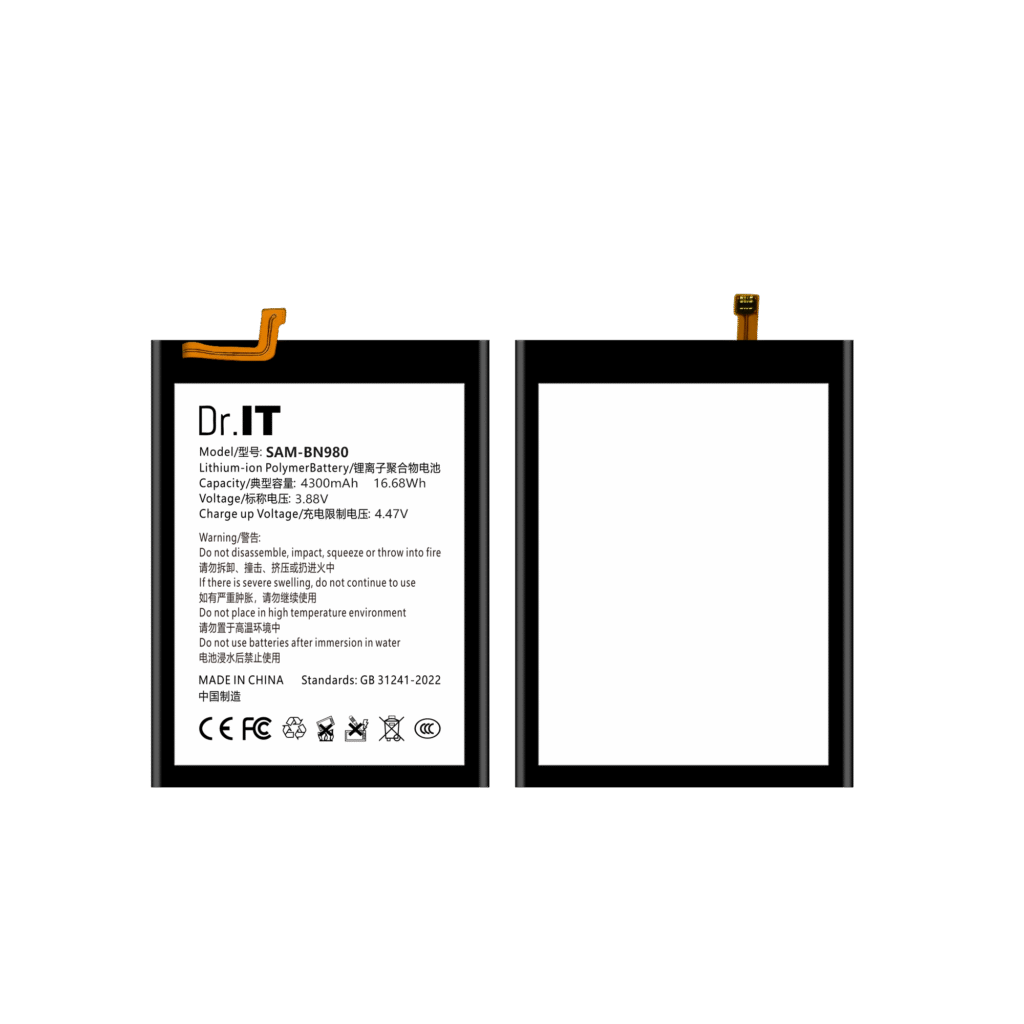
Every catalogue is finite, and every buyer eventually arrives with a reference that is not on the list: a device version that arrived late, a model that a supplier stopped listing, a repair on a phone that was never mainstream in your market. The tempting response is to order the nearest-looking reference from the catalogue and hope. That is the single most expensive shortcut in this trade, because a cell that fits physically can still be the wrong cell, and the mismatch is usually discovered by a customer rather than by the workshop. There is a workable route for an unlisted reference, and it starts before the order.
This guide is for repair shops, distributors and OEM buyers of replacement phone batteries. It covers how to identify an unlisted reference from the device itself, what a model code can and cannot tell you about compatibility, the physical checks that decide whether two references are interchangeable, when an equivalent reference is legitimate and when it is not, and why an unfamiliar reference should go through a sample before a bulk order. It states no supplier’s stock position or terms; those are confirmed per enquiry.
Step 1: get the reference from the cell, not from the device name
The fastest route to an unlisted reference is usually already in the workshop. When a device comes in for a battery replacement, the old cell comes out with it, and the artwork model text is printed on that cell. A photograph of the label — showing the model text, the capacity and the voltage — is enough for a supplier to confirm whether they hold that reference.
Where the cell is not available, the device version still narrows the search, but it does not identify the reference on its own. Two devices with the same marketing name can carry different cells, and the numeric part of a code carries no capacity information at all. The model code guide sets out why the code alone is not enough and how the artwork text should be recorded instead.
Step 2: separate “not listed” from “not the same”
There are two different problems hiding behind “I cannot find this battery”, and they need different answers.
- The reference is real but not in this catalogue. It exists, it is a normal catalogue reference, and another supplier or another range holds it. This is a sourcing question.
- The reference in your hand does not correspond to a device version anyone sells. It may be a market-specific variant, a leftover configuration, or a cell that was mislabelled. This is an identification question, and the answer may be that no equivalent exists.
Separating them early prevents the expensive version of the problem, which is ordering a “close” reference and discovering later that the device version was never that configuration. The test is whether the artwork text on the cell matches a documented reference with its own label values, or whether you are inferring the link.
Step 3: decide compatibility on physical criteria
If you are considering a different reference for the same device, the decision is mechanical before it is commercial. The fitment checklist lists the checks, and the order matters: connector type and pin count, flex cable shape and position, cell thickness and footprint, and the position of the protection board. Two references can share a device name and differ on every one of these.
| Check | What it tells you | What to record |
|---|---|---|
| Artwork model text on the cell | The reference as the manufacturer printed it | The text exactly as printed, in a photograph |
| Label capacity and nominal voltage | Which cell type it is, and whether a candidate matches on both | Both values, and whether they reconcile with the printed watt-hours |
| Connector and flex | Whether it can physically attach | Connector type, pin count, flex position |
| Dimensions and thickness | Whether it sits in the device without force or gap | Length, width, thickness |
| Protection board position | Whether the board sits where the device expects it | Position on the cell |
| Accessories and packaging | Whether the configuration you buy is the one your process expects | Adhesive, pull tab, flex tape, box format |
Capacity is not on that list on purpose. A cell with a larger capacity can be the wrong cell: if the thickness, the protection board or the connector differs, the extra capacity buys nothing. The battery evidence guide covers the related point about printed values and measured values, and it applies to candidates as much as to catalogue pages.
Step 4: choose the route deliberately
There are three ways to cover an unlisted reference, and they have different costs.
- Ask for the exact reference. Send the artwork text and the label values, ask whether the reference is available and what the minimum quantity and lead time are, and put the answer in writing. This is the cleanest outcome and should be the first attempt.
- Use a documented equivalent. If the reference is unavailable, a physically verified equivalent can be used — but only if the fitment checks pass on every criterion above, and only if it is recorded in your order list as a separate line with its own artwork text and label values. Never relabel it as the original reference, and never merge its quantity into that line.
- Define it yourself. For volumes that justify it, an OEM or private-label project defines the label, the artwork and the packaging. The OEM and private-label page sets out that route, and the private-label project process guide shows how the artwork and the sample approval run through it. It is slower than ordering from a stock reference and it is the right answer when the reference is a permanent part of your range.
For reference, catalogue pages such as the BN980 (4300 mAh, 3.88 V), the BN985 (4500 mAh, 3.88 V) and the BN935 (3200 mAh, 3.85 V) show the artwork text and the label values for their references — that is the level of detail an unlisted-reference enquiry needs.
Step 5: sample an unfamiliar reference before you order volume
Any reference that is new to you should go through a sample first, and the sample approval is a one-page record rather than an obstacle. It fixes the configuration in writing: the artwork text, the measurements, the accessories, the packaging and the lot reference of the sample. The sample approval checklist is the document to use, and it becomes the reference point for every later shipment of that reference — including when the claim comes back through the returns procedure.
One sample, once, is far cheaper than discovering a variant problem after a pallet has been consumed.
Step 6: write the reference into your own model file
When an unlisted reference is confirmed and approved, it belongs in the same file as everything else you order, with its artwork text, its label values, the device versions it was verified against, the date, and the sample reference. Two things go wrong when this is skipped. The reference is not repeated on the next order, because nobody can reconstruct it, and the equivalent line and the original line drift into each other, which is how a shop ends up shipping the wrong cell to a customer six months later. The device list guide covers how that file is built from the devices you service, and the mixed-model order list shows the format that keeps every reference on its own line.
What not to do
- Do not expand a model code into a device list on the strength of its digits.
- Do not treat “same as original” as a specification; ask for the artwork text and the label values.
- Do not substitute on capacity alone.
- Do not skip the sample for a reference you have never fitted before.
- Do not merge an equivalent into the original reference line, however convenient that would be for the order.
Availability, order minimums, delivery timing, after-sales conditions and the document set for your shipment are confirmed in writing for each enquiry. Send the artwork photograph, the device version and the quantities through the DoctorIT quotation page, and use the wholesale RFQ template so that an unlisted reference is requested in the same structured way as a stock one.
Battery installation and handling should be carried out by trained technicians, and lithium-ion batteries must be stored, transported and disposed of in line with the applicable local rules and the carrier’s requirements.
When a reference is not in the catalogue, the artwork model text is what identifies it, and the printed capacity, voltage and energy are what make it comparable to the ones you already carry; the capacity and watt-hour guide shows the check to run.