

November 14, 2026
Capacity in mAh, energy in Wh: reading the two numbers on a battery label
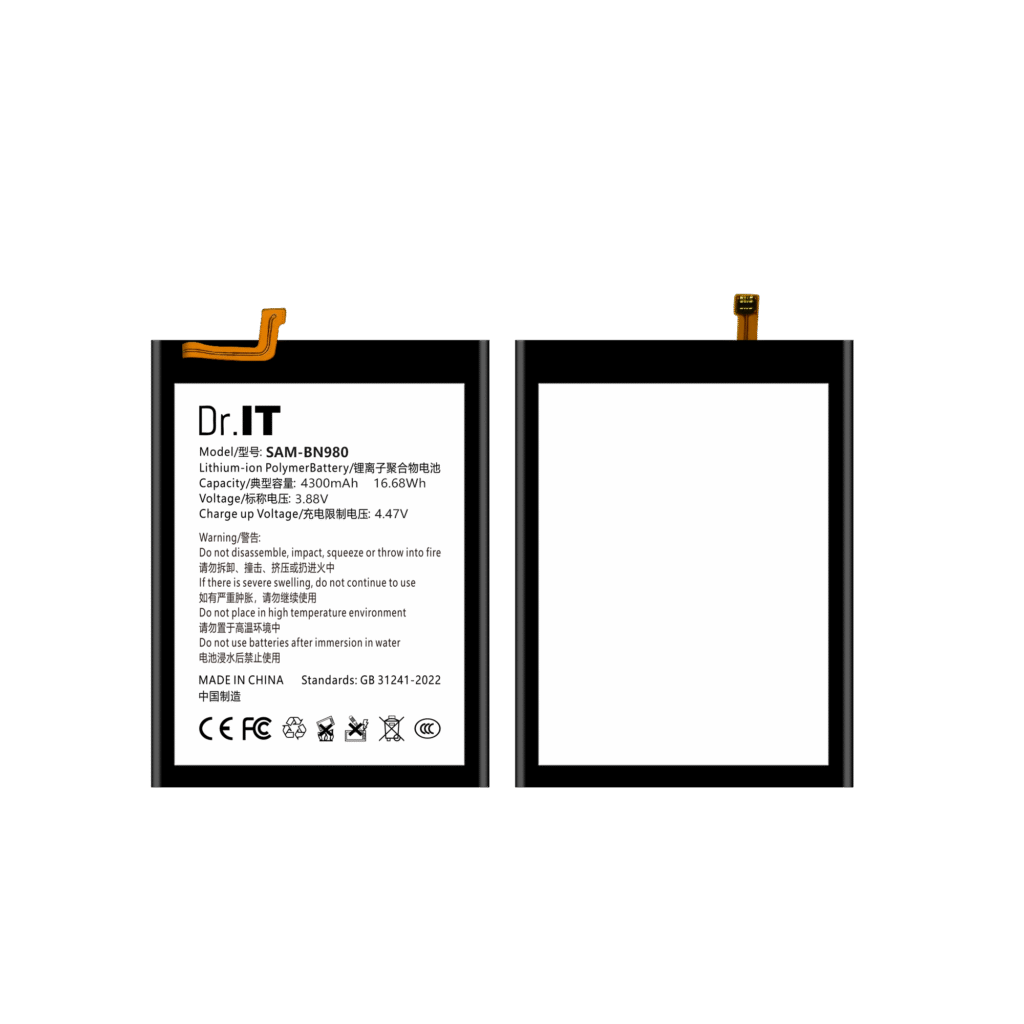
Two numbers on a replacement phone battery look like they measure the same thing, and they do not: one is a charge quantity in milliampere-hours, the other is an energy quantity in watt-hours. A buyer who compares only the mAh figures is comparing the wrong thing whenever two references run at different nominal voltages, and a buyer who ignores the arithmetic behind both numbers cannot tell a rounding difference from a real change in the cell. This guide is for repair businesses, distributors and OEM buyers of replacement phone batteries, and it works through what each printed number means, how to check the two against each other in seconds, what to do when they disagree, and how to compare references fairly. Every example used here is read from the original artwork published for that reference on this site, and the calculated values are labelled as calculated.
What the two numbers actually are
The artwork prints three related values in one block: the capacity as a milliampere-hour figure, the nominal voltage in volts, and, next to the capacity, the energy in watt-hours. The capacity line is printed as a typical capacity, which is a statement about a typical cell rather than a guaranteed minimum for every individual unit. The nominal voltage is the voltage the cell is designed to sit at during discharge; it is not the charge-limit voltage, which is a separate number printed a line further down.
The relationship between the three is simple enough to check by hand: watt-hours are roughly milliampere-hours multiplied by volts, with the milliampere-hours converted to ampere-hours first. So 4500 mAh at 3.88 V is about 4.5 × 3.88, which is 17.46 Wh. Any buyer can do this in ten seconds with a calculator, and it turns a printed claim into something checkable.
The check, worked on real references
| Reference | Capacity printed | Nominal voltage printed | Energy printed | Calculated from the two printed values |
|---|---|---|---|---|
| BS711 (Samsung) | 4500 mAh | 3.88 V | 17.46 Wh | 17.46 Wh — consistent |
| BA146 (Samsung) | 5000 mAh | 3.85 V | 19.25 Wh | 19.25 Wh — consistent |
| B-G5 (vivo) | 4000 mAh | 3.85 V | 15.40 Wh | 15.40 Wh — consistent |
| BG977 (Samsung) | 4500 mAh | 3.85 V | 17.33 Wh | 17.33 Wh — consistent |
| BM4T (Xiaomi) | 4520 mAh | 3.87 V | 17.40 Wh | 17.49 Wh — 0.5% above the printed value |
| HB396689ECW (Huawei) | 4000 mAh | 3.82 V | 15.30 Wh | 15.28 Wh — rounding level |
Two of these need a word of explanation, because they are the cases that come up in practice rather than the tidy ones. A difference of a few hundredths of a watt-hour, as on the Huawei reference, is what rounding does: the printed value was rounded to two decimal places in a direction that differs from a straight multiplication. A difference of a few percent, as on the Xiaomi reference, is a different thing: the printed energy and the printed capacity do not come from the same measurement basis, so neither number is wrong on its face and neither should be quietly adjusted.
What to do when the two do not agree
There are three possible explanations, and they need different responses.
- Rounding. Check whether the printed energy is within a rounding step of the calculated value. If it is, record it as rounding and move on.
- Different measurement basis. Capacity and energy are not always measured the same way, and a typical capacity can differ from a rated one. The honest response is to write down both printed values as they are, with the calculated value marked as calculated, and not to present one of them as corrected.
- A change in the cell or the artwork. If the artwork text, the capacity and the energy change between batches, that is a changeover rather than a rounding case, and it needs to be recorded against the batch. The artwork changeover guide covers how to handle that.
What to avoid is the tempting move of “correcting” the published number to make the arithmetic tidy. A catalogue value that has been silently adjusted is a value nobody can trace, and it is exactly the kind of change that makes a later claim unanswerable. The guide to what a battery label proves sets out why the printed artwork is the record and the calculation is only a check on it.
Why watt-hours are the fairer comparison
Two references can be listed in the same order and carry very different amounts of energy. Take 4000 mAh at 3.85 V, which is 15.40 Wh, against 4500 mAh at 3.88 V, which is 17.46 Wh: the second cell carries roughly 13% more energy, while the mAh figures differ by 12.5% and the two are running at different voltages. Across a catalogue the gap widens, because the nominal voltage in this range moves between about 3.82 V and 3.88 V depending on the cell.
So when a buyer is comparing two references for the same device, or deciding how much energy a customer is really getting, the watt-hour figure is the one that answers the question; the milliampere-hour figure only answers it when both cells run at the same voltage. The label field guide sets out the rest of the printed fields, including the charge-limit voltage and the warnings, and the model code guide covers why the code itself carries none of this information.
What capacity does not tell you
A capacity number is not a fitment statement, a life statement or a quality statement. It does not say which device version the cell fits, how many cycles it will survive, or how it was manufactured. Two cells with identical printed values can behave differently, which is why the acceptance decision is made on a sample and a dated record rather than on a photograph. The sample approval checklist covers that decision, and the cycle life and shelf life guide covers what happens to a cell over time. If a cell arrives swollen, punctured or warm, the damaged battery guide covers the handling, which comes before any of these questions.
Put the three numbers in the order file
The practical step is to make the check part of the record rather than a one-off calculation. Each order line should carry the reference, the artwork model text, the printed capacity, the printed nominal voltage, the printed energy and, where the two disagree, a note that the calculated value has been recorded as calculated. With that in place, a change between batches is visible, a claim has something to point at, and the next order is a copy rather than a re-derivation.
Reference pages such as the BN980 (4300 mAh, 3.88 V) and the BN985 (4500 mAh, 3.88 V) publish the artwork model text and the printed values for their references so the order line can be written straight from the page; the battery catalogue carries the rest of the range. Send your model list, quantities and destination through the DoctorIT quotation page, and start from the wholesale batteries page if you are setting the terms up for the first time.
Battery installation and handling should be carried out by trained technicians, and lithium-ion batteries must be stored, transported and disposed of in line with the applicable local rules and the carrier’s requirements.