

November 11, 2026
Why the prefix on a battery label matters: SAM, HW, XM and VO
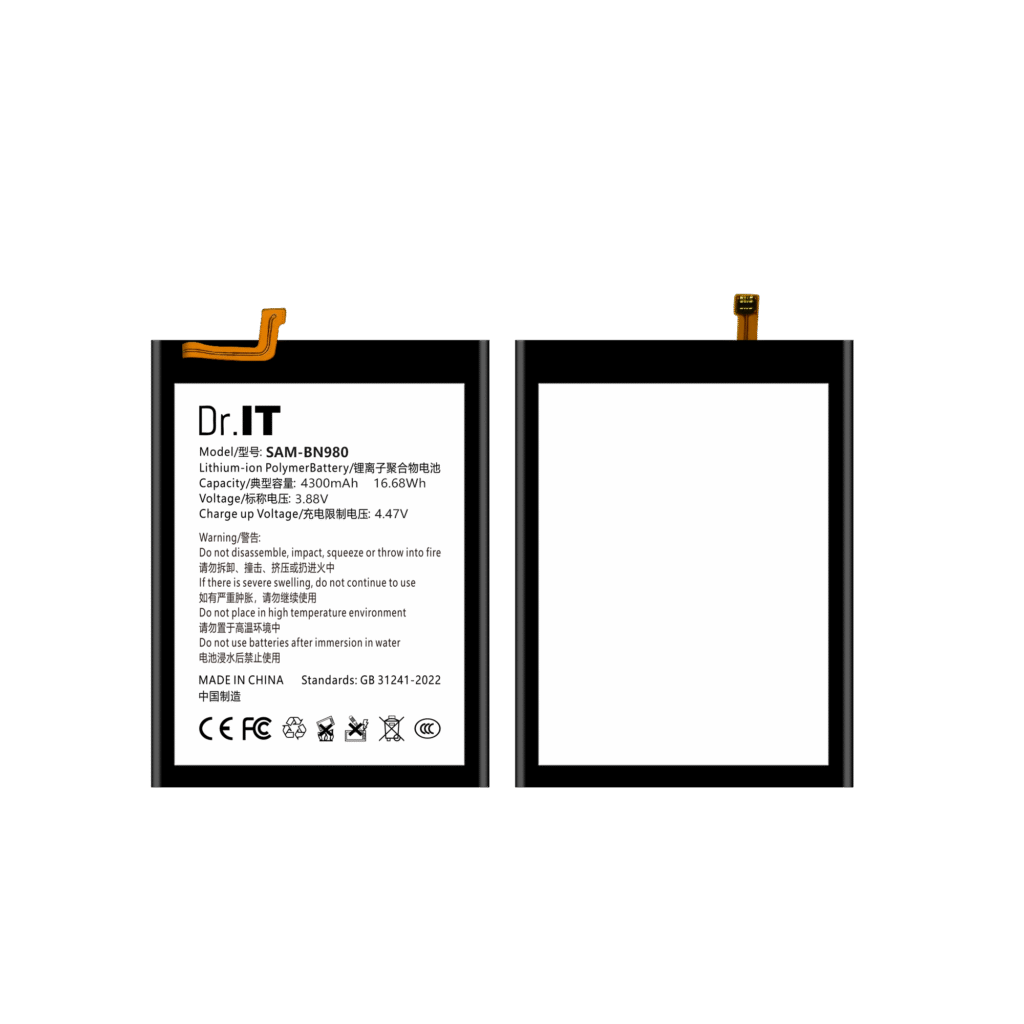
The model text printed on a replacement phone battery is not one string; it is usually a short prefix followed by a reference. The prefix identifies the device family the artwork belongs to, and it is the fastest sanity check a buyer has. If the prefix on the cell in your hand does not belong to the brand family of the reference you ordered, nothing else on the label matters, because the goods are not what you ordered. This is not a theoretical problem: in this catalogue, one reference has an attached artwork image that carries a different family’s model text, and the page for it says so rather than publishing a specification that cannot be verified. This guide is for repair shops, distributors and OEM buyers of replacement phone batteries, and it explains what the prefix can tell you, what it cannot, how to use it as a receiving check, and what to do when the prefix is not there at all.
The prefixes on the original artwork in this catalogue
| Prefix on the artwork | Brand family it identifies | Example from this catalogue |
|---|---|---|
| SAM- | Samsung | SAM-BN985, SAM-BA520, SAM-BS711 |
| HW- | Huawei | HW-HB416492EFW, HW-HB476586ECW |
| XM- | Xiaomi | XM-BM4T, XM-BM4U |
| VO- | vivo | VO-B-B9 |
These are the prefixes seen on the original DoctorIT artwork for the references published here, read from the artwork images themselves. They are not a universal standard: other suppliers print their own brand, their own part numbers, or nothing in that position at all. What makes the prefix useful is that within a catalogue it is consistent, which means it can be checked in seconds rather than interpreted.
What the prefix tells you, and what it does not
The prefix tells you which device family the artwork was produced for. That is genuinely useful, because device families are where errors cluster: a reference gets copied into the wrong brand group, a supplier sends the artwork for the wrong family, or a catalogue image is replaced with the image of a neighbouring reference. In each of those cases the prefix is the first thing that is wrong, and it is visible before anyone opens a box.
What the prefix does not tell you is anything about fitment. It says nothing about capacity, nothing about voltage, nothing about which device version the cell fits, and nothing about whether the reference exists in more than one form. A prefix that matches the expected family is a necessary check, not a sufficient one. The capacity, the nominal voltage and the charge-limit voltage still come from the label fields explained in the battery label guide, and the fitment question still has to be settled physically as set out in the fitment checklist.
How to use the prefix as a receiving check
The check costs a few seconds and it belongs at the point where a carton is opened rather than at the point where a cell is fitted.
- Read the model text on the cell and split it into the prefix and the reference.
- Compare the prefix with the brand family your order line says the reference belongs to.
- If the prefix does not match, stop there and query the supplier before the goods go on the shelf.
- If it matches, continue with the label values and the physical checks as usual.
Step three is the point of the exercise. A mismatch caught at receiving is a query about a shipment; the same mismatch found at the bench is a customer whose phone is open on the counter. The receiving and after-sales records guide covers the rest of the receiving routine and the record that has to be kept when something does not match.
When the prefix is missing or different
Two situations are common enough to plan for. The first is a supplier whose artwork carries their own brand in that position, so the prefix tells you the supplier rather than the device family. The second is a catalogue whose images are renders rather than original artwork, in which case there is no printed text to read at all.
Neither situation is a reason to stop ordering, but both change the verification route. If the artwork carries a supplier brand, the family has to come from somewhere else: the order line, the packaging, the documentation set, or the reference itself, and it should be recorded in the order file so the next order does not have to work it out again. If there is no readable artwork, then the label values on the goods are the only record, and they should be captured at the first receipt rather than assumed. The catalogue data guide covers what to ask a supplier when the images cannot be read, and the artwork changeover guide covers the case where the artwork text changes between batches.
Record the artwork text, not just the code
Once you have started reading prefixes, the natural step is to write the full artwork text on the order line rather than only the short code. The prefix then becomes part of the record, and a change in it is a visible event rather than something noticed later. This is the same practice the model code guide argues for with the rest of the code: the numeric part carries no capacity information, and the artwork text is the field that survives a rebrand, a catalogue tidy-up and a supplier change.
Product pages such as the BN980 (4300 mAh, 3.88 V) and the BN985 (4500 mAh, 3.88 V) publish the artwork model text for their references so that the order line can be written directly from the page; the battery catalogue carries the rest of the range.
Send your model list, quantities and destination through the DoctorIT quotation page, and start from the wholesale batteries page if you are setting the terms up for the first time. Availability, order minimums, timing and after-sales conditions are confirmed in writing for each enquiry and each shipment, against the scope you send.
Battery installation and handling should be carried out by trained technicians, and lithium-ion batteries must be stored, transported and disposed of in line with the applicable local rules and the carrier’s requirements.