

November 13, 2026
Depth or breadth: how a distributor should build its battery assortment
Every distributor eventually faces the same two questions: how many battery references should the catalogue carry, and how deep should the stock go on each of them? Answer them by instinct and you end up with a warehouse full of references that never sell and an empty shelf for the ones that sell every week. Answer them with a method and you get an assortment that matches how the business actually earns. This guide is for distributors and trade buyers of replacement phone batteries, and it sets out how to build an assortment from your own demand rather than from a supplier’s catalogue size, how to trade depth against breadth, how to avoid the two classic failures — dead stock and stock-outs on the references that matter — and how to keep the assortment alive as demand moves. It contains no figures from any supplier: pricing, minimums and availability are confirmed per enquiry, and the method here works on your own records.
Start from demand, not from the catalogue
The wrong starting point is the supplier’s catalogue, because it is a list of what they can make rather than a list of what your customers ask for. The right starting point is the reference list you have already sold, over a period long enough to be meaningful. From that list you can separate two things that look identical in a spreadsheet: references that sell steadily and in quantity, and references that sell slowly and occasionally. The first kind earns its place through volume; the second earns its place through coverage — a customer who cannot get one reference does not necessarily place the rest of the order elsewhere.
Write the reference, the units sold, and the number of separate orders, per period. The order count matters as much as the unit count, because a reference that appears in many small orders is a different proposition from one that appears in a few large ones: it occupies shelf space, it needs a reorder point, and it is the reference a customer will complain about when it is missing.
Depth and breadth are the same decision
| Dimension | Deep and narrow | Broad and shallow |
|---|---|---|
| Cash tied up | Concentrated in a few references | Spread thinly across many |
| Stock-out risk | Low on the covered references | Higher on every reference |
| Dead stock risk | Low if the references genuinely sell | High on the slow tail |
| What it needs to work | Reliable demand for those references and a supplier who can repeat them | A catalogue large enough that the slow references are still available when needed |
| What it looks like when it fails | A gap on the reference that earns the most | A warehouse of models nobody asks for |
The table is the argument for working both at once: a small group of references carried deep, and a longer tail carried shallow so that coverage is preserved without cash being spent on it. The mistake is doing only one of the two — a pure deep assortment cannot answer a request for a reference outside the top group, and a pure broad assortment turns the inventory into a museum.
What a shallow tail needs from the supplier
Carrying a reference thinly only works if you can reorder it without a long wait, and that depends on terms rather than on hope. Three things determine whether a tail reference is viable: the minimum quantity per order, whether it can share a carton with other references, and how quickly a repeat order moves. The quote comparison guide covers how to get those terms stated in writing, and the buying unit guide covers how the packaging unit affects both the freight and the minimum you have to hold.
If a supplier cannot state those three things, the tail is not a tail, it is a hope. That is a fair question to put in the enquiry, and the answer belongs in the file with the rest of the terms.
Use the order file, not a spreadsheet of guesses
The assortment is only as good as the record behind it. Once references have been counted by units sold and by order count, the next step is to make that record the thing you actually order from: one line per reference, with the artwork model text, the buying unit and the label values, so the order file and the demand record are the same file. The repeat order guide sets out how to standardise that file after the first order, and the stock planning guide covers how to size the depth per reference against consumption.
The device mix is the other half of the assortment question. A distributor whose customers repair mostly one brand does not need the same range as one whose customers bring everything, and the catalogue here is organised by brand precisely so that the demand record can be organised the same way. The device list guide covers building the demand side of the list, and the mixed-model order list is the format that keeps every reference and its artwork text on one line.
The two classic failures
Dead stock. A reference that has not sold within the period you set is either a coverage decision or a mistake. If it is genuinely requested occasionally, keep it shallow; if it has not been requested at all, it is not an assortment, it is clutter — and it is holding cash and shelf space that a slower reference with real demand could use. Setting the period in advance is what stops this from being a matter of mood.
Stock-outs on the references that matter. This is the expensive failure: the reference that carries the volume is the one that must never be missing, and a shallow assortment makes it missing exactly when a shipment is delayed. The stock planning guide covers setting the cover for the references that carry the volume, and the receiving and after-sales records guide covers keeping the record that tells you how quickly a repeat order actually moves.
Keep the assortment alive
Demand moves, and an assortment built once is stale within a season. Two habits keep it alive. The first is a periodic review on a fixed date — not whenever a reference looks awkward — where the demand list is rebuilt and the depth, the coverage and the tail are each decided explicitly. The second is a rule for what happens when a reference is discontinued or when its artwork changes: the change is recorded, the stock is worked down, and the listing text is updated once, dated, rather than quietly substituting one artwork for another under the same code. The artwork changeover guide covers that case, and the catalogue data guide covers what to ask a supplier so that a change is visible before a shipment arrives.
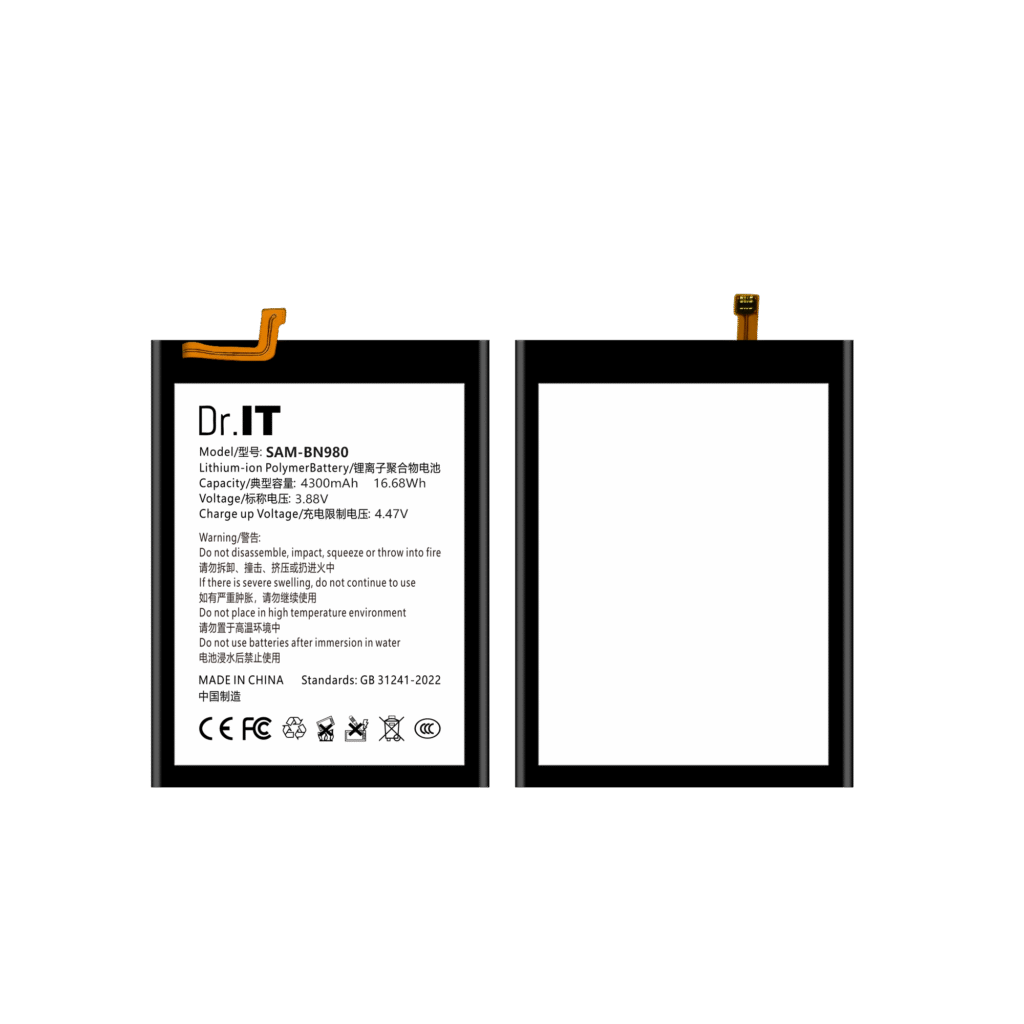
Product pages such as the BN980 (4300 mAh, 3.88 V) and the BN985 (4500 mAh, 3.88 V) publish the artwork model text and label values for their references so the order file and the listing can be written from the page; the battery catalogue carries the rest of the range, organised by brand and capacity tier. Send your reference list, quantities and destination through the DoctorIT quotation page, and start from the wholesale batteries page if you are setting the terms up for the first time.
Battery installation and handling should be carried out by trained technicians, and lithium-ion batteries must be stored, transported and disposed of in line with the applicable local rules and the carrier’s requirements.