

November 1, 2026
Phone battery specification sheet for OEM and private-label projects
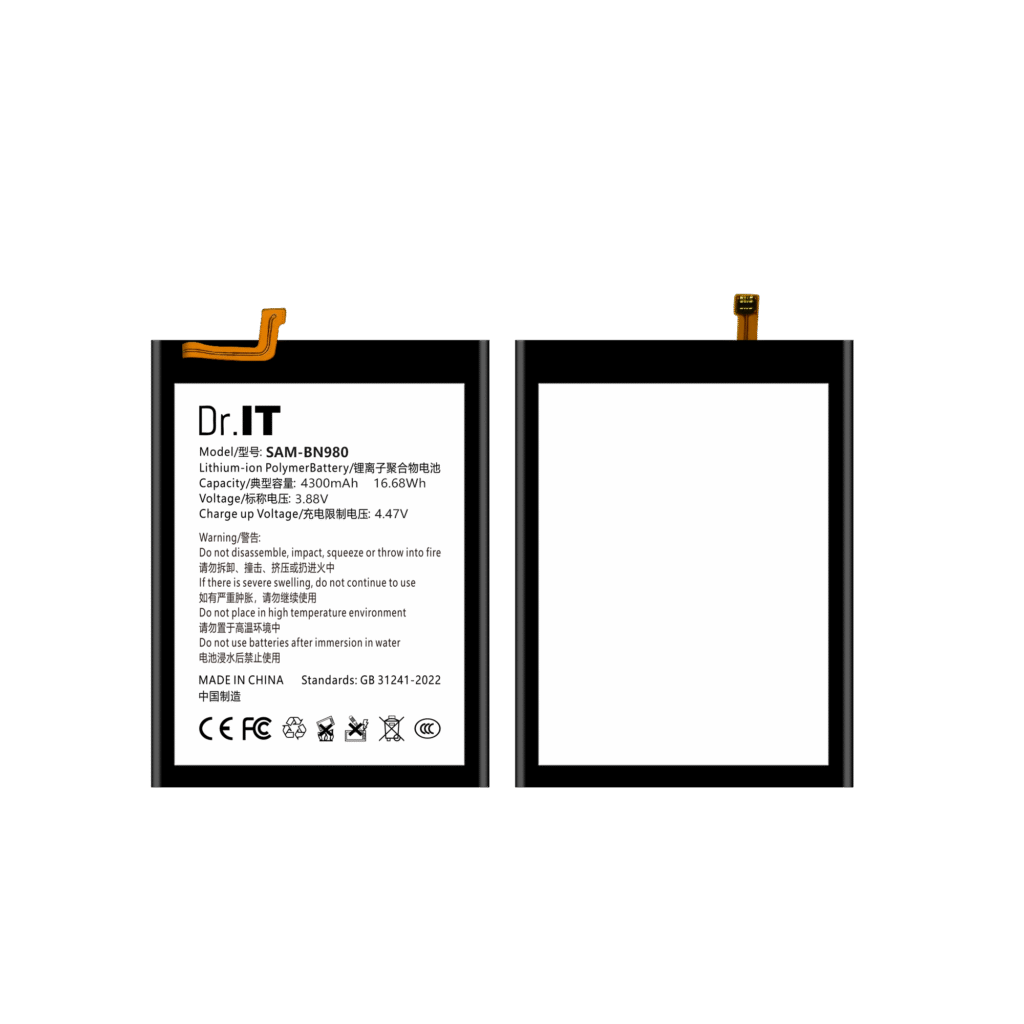
A wholesale enquiry and an OEM project need two different documents. The enquiry asks a supplier for a price against a model list. The specification tells the supplier what to build. Buyers who start with a quotation and negotiate the specification afterwards end up with an offer that is cheap on paper and expensive to fix: the artwork is wrong, the label field does not match the device, the carton does not hold the accessory set, and the files have to be redone.
This guide is for buyers running a private-label or OEM project on replacement phone batteries. It sets out the fields a specification has to contain, what each one should be written so it can actually be checked, and which decisions to fix before the artwork is approved. It is written from the position of the party specifying, not from a manufacturer’s catalogue, so it works the same way whichever supplier is asked to quote it.
The eight blocks a battery specification needs
| Block | What it fixes | The fields to write |
|---|---|---|
| Product identity | Which cell is being built, unambiguously | Catalogue reference, artwork model text, listed device family and device version, and the catalogue URL |
| Label values | The numbers printed on the cell | Capacity, nominal voltage, the charge-limit voltage, and the energy figure — each as a separate value |
| Mechanical | Whether it goes into the device | Connector type and orientation, cell dimensions with tolerance, flex position, adhesive and pull-tab arrangement |
| Labelling and artwork | What is printed on the battery and where | Label size, print area, layout, language, required marks, warning text, and the artwork revision number |
| Accessories and packaging | What arrives in the box and how it is packed | Flex pull-tab, adhesive strips, pouch or tray, carton count, carton dimensions, pallet configuration |
| Documents | What travels with the shipment | Invoice and packing list format, transport document, handling and storage statement, and any test report you need |
| Logistics | How the goods reach you | Incoterm, ship-to, packaging and marking for lithium transport, carton labelling and pallet marks |
| Quality acceptance | How the goods are judged on arrival | Sample approval procedure, incoming check scope, defect categories, and what happens on a mismatch |
The value of writing it this way is that each field has an owner and a check. A label capacity is checked against the artwork and the invoice; a dimension is checked with a calliper against the sample; a document is checked by name and revision. A field that cannot be checked is a wish, and a wish that reaches production is a cost.
Write label values as separate numbers
The three electrical fields are the ones most often collapsed into one. Capacity, nominal voltage and the charge-limit voltage are different numbers with different meanings, and the charge-limit value is the one most often left out. Writing them on one line as “5000 mAh 3.87 V” makes the third number easy to lose, and a missing charge-limit value ends up decided by whoever writes the artwork.
Ask for the energy figure as well, and check it against the arithmetic: capacity multiplied by nominal voltage. If the printed figure and the calculation do not agree, that is a question to settle in writing before the artwork is approved, not after production. The label guide works through what each field means and how a mismatch arises.
Separate what you can verify from what is a claim
Not every line of a specification can be checked on the goods. A dimension is measured. A label value is read. A cycle-life figure or a quality grade is a claim about a test programme, and it needs the method, the sample and the report behind it, or it needs to be dropped from the specification altogether. Writing “high quality” into a specification means nothing can be rejected against it; writing “cycle life to 80% of rated capacity, 500 cycles at 25 °C, per the attached report” gives the supplier something to answer and gives you something to check. The cycle life and shelf life guide covers how these figures depend on their conditions.
The same applies to certification marks. The artwork may carry marks such as CE or FCC, and the packaging and artwork approval checklist covers how to record what appears on the label and what evidence you hold for it. A mark on a label is not by itself evidence of a test report.
Fix the artwork before the packaging
Artwork revision control is where OEM projects usually lose time, because packaging is usually designed in parallel with the artwork and both get approved together. The workable order is: approve the label artwork first, because the label content drives the box content — the model code, the artwork text, the capacity and the voltage all appear on the carton and on the outer packaging. Then the packaging artwork follows the label, and only then does the first pre-production sample get built.
Keep one revision number per artwork file, and record which revision was approved on which date together with the sample it was approved on. The private-label project process guide sets out the sequence of approvals for a project, and the sample approval record is where the accepted configuration is written down.
State the acceptance route, not just the requirement
The last block is the one that decides whether a project ends well. A specification that only says what the goods should be leaves every disagreement about what happens when they are not. A useful acceptance section names: which sample is the reference, what is checked on each incoming delivery, what counts as a defect and what counts as a cosmetic difference, and what the remedy is — replacement, credit, or rework — together with the time limit for raising it.
That is also where the shipping conditions belong. A battery project has to state how the goods are packed and marked for transport, and what handling conditions apply, because those are requirements on the project rather than details of the shipment. The shipping and storage guide covers what to ask for, and the importing guide covers the terms to settle with your broker once the goods are on the way.
For the models themselves, the catalogue page for each reference states the artwork text and the label values, so the specification can be built from the same figures the quotation is based on — for example the BN980 (4300 mAh, 3.88 V), the BN770 (4500 mAh, 3.86 V) and the BP56 (5065 mAh, 3.87 V). Availability, order minimums, production timing, packaging options and after-sales conditions are confirmed in writing for each project. Send your model list and the specification fields through the DoctorIT quotation page, or start from the OEM and private-label page if the project is still being scoped.
Battery installation and handling should be carried out by trained technicians, and lithium-ion batteries must be transported, stored and disposed of in line with the applicable local rules and the carrier’s requirements.
For an OEM specification, write the artwork model text exactly as printed rather than paraphrasing it; the artwork prefix guide explains what that text does and does not establish.