

November 15, 2026
Packaged retail batteries or bulk cells: what differs and how to specify each
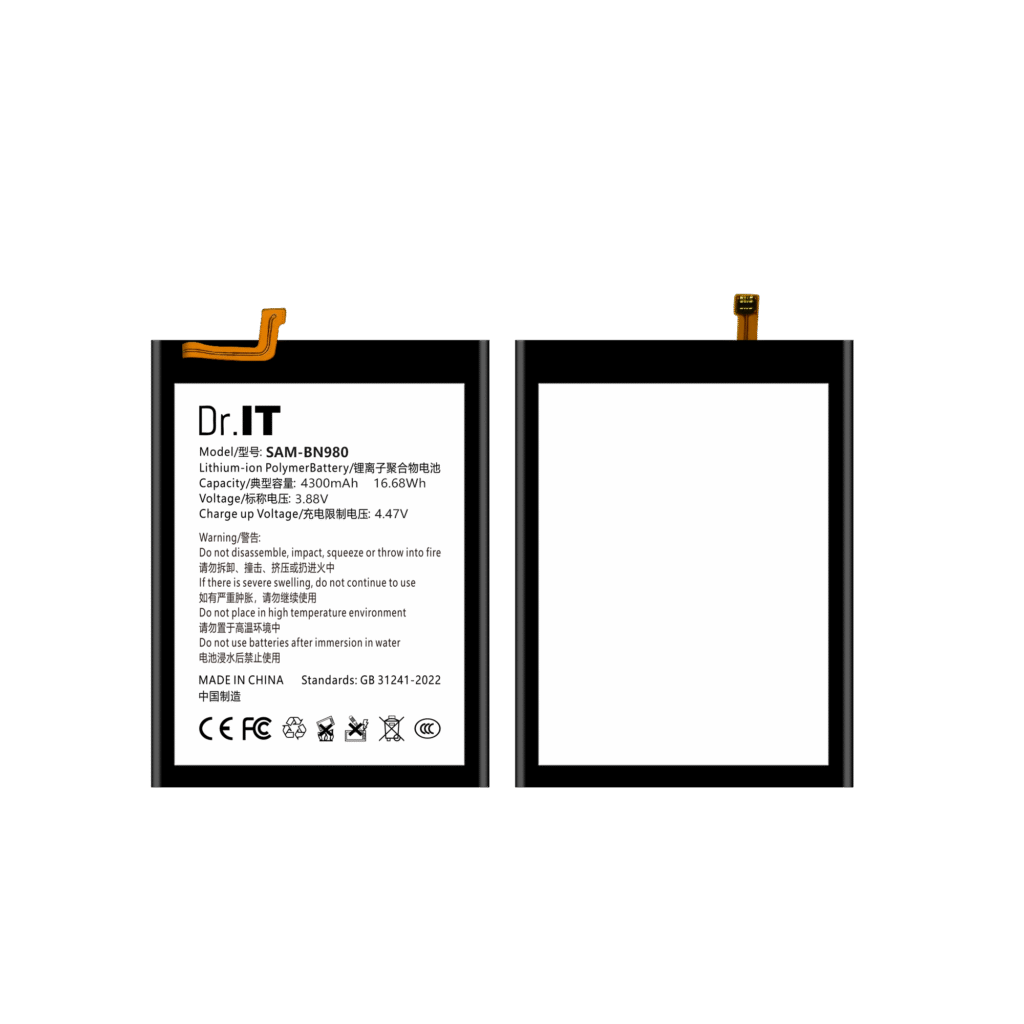
Two families of replacement phone battery sit in this catalogue, and they are not the same product in different packaging. The artwork tells you which family a reference belongs to before anything else does: one line of model text starts with the brand prefix and carries a bilingual label with Chinese warnings, while the other starts with RP-, carries an English-only label, and comes in a printed retail box marked as a high capacity phone battery. The two families even print a different standard reference on the artwork. A buyer who treats them as one product will get the wrong buying unit, the wrong expectations for the counter, and the wrong paperwork. This guide is for repair businesses, distributors and OEM buyers of replacement phone batteries, and it sets out how to tell the families apart, what each one is actually for, what differs in the printed label, and how to write either of them into an order file so that the goods arriving match what was ordered. Every example used here is read from the original artwork published for that reference on this site.
Two artwork families, read from the label
| What the artwork shows | Bulk cell family | Packaged retail family |
|---|---|---|
| Model text on the artwork | Brand prefix plus reference: SAM-, HW-, XM-, VO- | RP- plus the same style of reference: RP-VO-B-M3, RP-VO-B-Z5 |
| Example references read here | SAM-BN985, SAM-BG977, VO-B-G5, VO-B-B9 | RP-VO-B-M3 (5000 mAh, 3.87 V), RP-VO-B-Z5 (4500 mAh, 3.85 V) |
| Packaging shown | The cell itself, no retail box | A printed retail box with a hanging tab, marked HIGH CAPACITY PHONE BATTERY |
| Label language | Chinese and English on the same block | English only |
| Warnings printed | Do not disassemble, impact, squeeze or throw into fire; if there is severe swelling, do not continue to use; do not place in a high temperature environment; do not use after immersion in water | Use only original chargers; do not disassemble or short circuit the battery; must be recycled or disposed of properly; may explode if damaged or disposed of in fire; do not push or impact |
| Standard reference printed | GB 31241-2022 | GB 31241-2014 |
Two things in that table are worth pausing on. The first is the warning text: the packaged family’s printed warnings are not the same words as the bulk family’s, and they are not a translation of them. A buyer who writes “the same warnings as the standard cell” into an order file is writing something the supplier cannot check against, because the artwork genuinely differs. The second is the standard reference printed on the artwork, which differs between the families. That is reported here as what the artwork shows; it is not a certification claim, and nothing on this site should be read as one.
What each family is actually for
The bulk cell is the trading unit for repair distribution. It is the form that gets counted into cartons, split into the buying units that a distributor actually orders, and handed to a technician who fits it to a device. The economics of that form are about carton quantity, how many pieces one carton holds, and how the order is split across references.
The packaged retail battery is a finished saleable unit: a cell in a printed box with a hanging tab, ready for a counter, a shelf or a parts counter in a repair shop. That is why it exists, and it is why it is priced and shipped differently. For a distributor whose customers are shops rather than benches, a packaged unit is a different commercial product even when the reference underneath it looks familiar.
The bulk and packaged buying unit guide covers how the buying unit changes what an order means and what freight and minimums follow from it, and the packaging artwork guide covers what has to be fixed in writing when a packaging detail changes.
What to check when the goods arrive
Because the families look different on the outside, receiving can check the family as well as the reference. When a carton is opened:
- Read the model text on the cell and confirm the prefix family: a brand prefix means a bulk cell, RP- means the packaged family.
- Confirm that what arrived is what was ordered in the family sense, not only in the reference sense.
- For the packaged family, check that the retail box is present and undamaged, since the box is part of the unit.
- Record which warning text version and which printed standard reference the artwork carries, so that a later batch can be compared against it.
The receiving and after-sales records guide covers the rest of the receiving routine and the record to keep when something does not match, and the label field guide covers how to read the capacity, voltage and energy fields on either family.
Writing either family into an order file
The order line has to distinguish the families, otherwise the difference is discovered at the point where it is most expensive. A workable line carries: the catalogue reference, the artwork model text including its prefix, the family (bulk cell or packaged retail), the label values (capacity, nominal voltage, the printed energy), the printed charge-up voltage, and the buying unit.
The model code itself carries no capacity information and no family information, which is the reason the prefix has to be written out rather than summarised. The model code guide covers that, and the artwork prefix guide explains why the first part of the model text is the fastest check available at receiving.
Where a reference is offered in both families, treat them as two items until the artwork text confirms which one an order line refers to. That is not a formality: the two families differ in packaging, in the printed warning text and in the printed standard reference, so an order that says only the reference has left the decision open.
For OEM and private-label work
If the pack is going to carry the buyer’s own brand rather than the original artwork, the family has to be chosen before anything is printed, because the packaging artwork is what carries the model text and the warnings. The private label project guide covers the sequence, and the OEM specification sheet guide covers the fields that a specification has to state, including the artwork model text written exactly as printed.
Product pages such as the BN980 (4300 mAh, 3.88 V) and the BN985 (4500 mAh, 3.88 V) publish the artwork model text and label values for their references, and the battery catalogue carries the rest of the range by brand. Send your reference list, quantities and destination through the DoctorIT quotation page, and start from the wholesale batteries page if you are setting the terms up for the first time.
Battery installation and handling should be carried out by trained technicians, and lithium-ion batteries must be stored, transported and disposed of in line with the applicable local rules and the carrier’s requirements.